 DACHENG PRECISION MACHINERY

Our products are mainly used in electric motors, covering traditional fields such as machinery manufacturing, automobile industry, medical equipment and various household appliances, and we have also made achievements in emerging fields such as robot bearings.
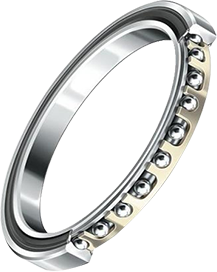
 Description
Robot bearings are essential components in industrial robots, primarily used to support the rotational and translational movements of the robot, as well as to bear the robot's load, thereby ensuring the precision and stability of the robot's operations. The main types of robot bearings include cross roller bearings, thin-walled bearings, bearings for harmonic drives, and spherical plain bearings (often referred to as joint bearings).
Robot Bearing: Precision Motion Components for Advanced Automation Systems
Robot bearing technology has become a foundational element in modern automation, supporting the accuracy, repeatability, and durability demanded by today’s robotic systems. As industrial robots move beyond traditional manufacturing into logistics, healthcare, electronics, and collaborative applications, bearings designed specifically for robotic motion face stricter performance requirements than conventional industrial bearings. For B2B manufacturers, equipment integrators, and procurement decision-makers, understanding robot bearing design and selection is essential to ensuring system reliability and long-term value.
Global automation is shifting toward higher precision, higher speed, and greater flexibility. Industrial robots are no longer confined to isolated production cells; they now operate continuously, interact with humans, and perform tasks requiring micron-level positioning accuracy. This evolution has driven demand for robot bearing solutions capable of handling complex loads, frequent acceleration and deceleration, and extended operating cycles without performance degradation.
Markets such as automotive assembly, semiconductor manufacturing, battery production, and warehouse automation all require robot bearings that combine compact size with high rigidity and long service life. At the same time, total cost of ownership has become a central purchasing metric, pushing end users to prioritize reliability over initial component cost.
A robot bearing is not defined by a single bearing type, but by its functional role within robotic joints, axes, and actuators. Unlike general-purpose bearings, robot bearings must support multi-directional loads while maintaining high positional accuracy and minimal backlash.
Key technical characteristics include:
High rigidity to maintain positioning accuracy under dynamic loads
Low friction torque for precise motion control
Stable preload to eliminate play during repeated direction changes
Consistent performance over long duty cycles
Advanced robot bearing designs often integrate optimized raceway profiles, controlled internal clearances, and specialized lubrication systems to meet these requirements.
Common robot bearing configurations include thin-section ball bearings, crossed roller bearings, angular contact bearings, and harmonic drive support bearings. Each serves a specific function depending on axis design, load direction, and motion profile.
Thin-section bearings enable compact joint design and reduced inertia
Crossed roller bearings offer high rigidity and load capacity in limited space
Angular contact bearings support combined axial and radial loads with precision
Robot bearing rings are typically manufactured from high-purity bearing steels or stainless steels for corrosion-prone environments. In some high-end applications, hybrid designs incorporating ceramic rolling elements are used to reduce friction and improve wear resistance.
Heat treatment processes are tightly controlled to achieve uniform hardness and dimensional stability. Even minor variations can impact preload consistency and motion accuracy.
Superfinishing of raceways, precision grinding, and strict geometric tolerances are critical. Manufacturing quality directly influences vibration levels, noise, and long-term repeatability—factors that directly affect robotic performance.
Several factors determine whether a robot bearing performs reliably in real-world applications:
Load Characteristics
Robots experience dynamic and moment loads rather than constant static loads.
Speed and Acceleration Profiles
Frequent start-stop cycles increase fatigue and thermal stress.
Preload Accuracy
Incorrect preload leads to either excessive friction or positioning errors.
Lubrication Stability
Grease degradation or migration affects torque consistency over time.
Installation and Alignment
Even high-quality bearings can fail prematurely if mounting accuracy is poor.
Understanding these factors allows engineers and buyers to evaluate bearings beyond catalog ratings.
Selecting a robot bearing supplier involves more than comparing specifications. Reliable suppliers should demonstrate:
Proven experience in robotics or precision motion applications
Transparent material sourcing and quality control systems
Consistent manufacturing repeatability across batches
Engineering support for application-specific requirements
Stable long-term supply and lifecycle management
For OEMs and integrators, supplier collaboration during the design phase often prevents downstream performance issues.
Despite technological advances, several challenges persist:
Bearings selected for load capacity but not motion accuracy
Inconsistent torque caused by lubrication instability
Premature wear due to underestimated dynamic loads
Limited standardization across robot platforms
These issues often surface only after systems are deployed, making upfront technical evaluation critical.
Robot bearing solutions are widely used in:
Industrial articulated robots for welding and assembly
SCARA and delta robots in electronics manufacturing
Collaborative robots requiring smooth, low-resistance motion
Automated guided vehicles and robotic arms in logistics
Medical and laboratory automation systems
In each case, bearing performance directly influences precision, safety, and throughput.
Several trends are shaping the future of robot bearing technology:
Increased use of compact, high-rigidity bearing designs
Growing demand for low-maintenance or sealed-for-life solutions
Integration of condition monitoring to predict bearing wear
Expansion of robotics into cleanroom and corrosive environments
As robots become more autonomous and widely deployed, bearings will continue to evolve from standard components into highly engineered motion systems.
Are robot bearings interchangeable with standard industrial bearings?
In most cases, no. Robot bearings are optimized for precision and dynamic motion rather than static load capacity.
How important is preload in robot bearings?
Preload is critical. Incorrect preload affects accuracy, torque, and bearing life.
Do robot bearings require special lubrication?
Yes. Lubrication must remain stable over long cycles and varying temperatures to ensure consistent motion.
Robot bearing technology underpins the performance and reliability of modern robotic systems. As automation becomes more precise and demanding, the role of the robot bearing expands from a supporting component to a critical engineering element. For B2B buyers and technical decision-makers, understanding bearing design, quality factors, and supplier capabilities is essential to achieving predictable performance and long-term operational efficiency.
High-precision Thin-walled Bearings For Automation And Robotics
High Precision Deep Groove Ball Bearings
High-precision Deep Groove Ball Bearings For Precision Instruments
Precision-grade Stainless Steel Bearings For Exacting Standards

Vincent Liang

+86 137 5749 2228

liangzexi@cxbearings.cn

No.195, Dongshaobei Road, Jiangbei District, Ningbo City, Zhejiang Province, China


Copyright © Zhejiang Dacheng Precision Machinery Co., Ltd. All Rights Reserved.


