 DACHENG PRECISION MACHINERY

In today's highly automated manufacturing industry, industrial robots have become an indispensable core equipment for production lines. As the key guarantee of robot motion accuracy, the performance maintenance of high-speed miniature ball bearings is directly related to the work efficiency, positioning accuracy and service life of robots. This article will comprehensively analyze the lubrication and maintenance technology of high-speed miniature ball bearings in industrial robot joints, and provide you with a complete set of maintenance solutions from basic theory to practical operation. We will deeply discuss the lubrication characteristics of different types of bearings, scientific and reasonable lubrication cycle formulation methods, accurate lubrication operation technology, and systematic condition monitoring strategies to help you effectively extend the service life of robot bearings, reduce equipment failure rate, and improve production efficiency.
High-speed miniature ball bearings are one of the most precise mechanical parts in the joints of modern industrial robots, and their performance directly determines the motion accuracy, repeated positioning ability and service life of the robot. In a typical six-axis industrial robot, each rotating joint contains several sets of precision bearings that are subjected to complexity at high speedsRadial force、Axial forceandOverturning moment。 Taking the common 20kg load robot as an example, the speed of its wrist joint bearing can reach more than 10,000 rpm, and the operating temperature range fluctuates between -20 °C and 120 °C.
The core role of bearing lubrication is mainly reflected in four aspects:Reduced friction、Reduced wear and tear、Thermal coolingandAnti-rust and anti-corrosion。 When the lubrication is insufficient or the lubricant performance deteriorates, the metal surface inside the bearing is in direct contact, and the friction coefficient rises sharply, which not only leads to an increase in energy consumption, but also causes a temperature increase, a change in clearance, and ultimately a decrease in the positioning accuracy of the robot. Data shows that about 42% of joint failures in industrial robots are due to early bearing failure caused by poor lubrication. At high speeds, unlubricated bearing life can be reduced to 1/10 of normal or less.
Industrial robot bearings face Special challenges Including: high temperature (up to 80-120°C) generated by continuous operation, vibration harmonics caused by harmonic reducer, dust and corrosive media (such as cutting fluid, welding spatter) in the production environment, etc. All of these factors accelerate the degradation of lubricant performance. Taking the automobile welding production line as an example, the ambient temperature is often above 50 °C, and there are metal dust and welding sputtering at the same time, and the lubrication cycle of the robot spherical bearing is usually shortened by 30%-40% compared with the clean environment.
differenttypes of industrial robotsThere is also a differentiated need for bearing lubrication. Cartesian coordinate robots mainly use linear bearings and ball screws, and the extreme pressure requirements for grease are relatively low; The rotating spherical bearings of multi-articulated robots require grease with excellent resistance to fretting wear. Clean robots used in the food and pharmaceutical industry also require lubricants to be FDA or NSF H1 certified and not to contaminate the product. Understanding these differences is fundamental to developing an effective lubrication strategy.
With the industrial robot to Acceleration、High accuracy Development, the DN value (bearing inner diameter in mm× rotational speed) of the new generation of robot bearings has exceeded 1.0×10⁶, which puts forward higher requirements for lubrication technology. Traditional mineral oil-based greases have been unable to meet the demand, and new greases with fully synthetic base oils and special additives have gradually become the mainstream choice. At the same time, advanced means such as intelligent lubrication system and condition monitoring technology have also begun to be applied to the field of high-end robot maintenance.
Choosing the right lubricant for industrial robot joints is a multi-factor process Technical decisions。 Different from ordinary industrial bearings, high-speed miniature ball bearings in robot joints have more stringent performance requirements for grease. An ideal robot bearing grease should have High and low temperature stability、Excellent shear resistance、Good corrosion resistance and Long service life and other characteristics. Poor lubricant selection not only does not provide effective protection, but can lead to premature bearing failure, resulting in significant production losses.
From the perspective of base oil types, robot bearing greases are mainly divided into: Mineral oil based、Synthetic hydrocarbon groups and Ester oil base Three categories. Mineral oil-based greases are less expensive, but they are not good at high temperatures and long life performance, and are suitable for low- to medium-speed, light-duty robots. Synthetic hydrocarbon-based (PAO) greases have a wider temperature range (-40°C to 150°C) and a longer service life, making them the preferred choice for most industrial robots. Ester oil-based greases are used in special industries such as food and medicine because of their excellent boundary lubrication properties and biodegradable properties. For robots operating in extreme environments, such as foundries, it is often necessary to choose special greases based on polyether or silicone, which can withstand temperatures above 200°C and large amounts of dust.
Grease Consistency grade (NLGI rating) is also crucial. Industrial robot spherical bearings are generally recommended with NLGI grade 2 (working taper 265-295) or grade 1.5 (310-340) grease. Excessive grease (such as NLGI grade 3) will increase the starting torque and affect the dynamic performance of the robot; Greases that are too soft, such as NLGI Class 1 or below, can be thrown out during high-speed rotation, resulting in insufficient lubrication. Due to space limitations, it is advisable to use a grease with a lower base oil viscosity (ISO VG32-68) for miniature ball bearings to reduce oil agitation loss and temperature rise; Larger spherical bearings can be greased with medium to high viscosity ISO VG100-150 to create a thicker film of protection.
Modern high-performance robot bearing lubricants often contain a variety of lubricants Functional additives Include:
antioxidant: Delay the oxidative deterioration of grease at high temperature and prolong the grease change cycle
Extreme pressure anti-wear agent (e.g. molybdenum disulfide, graphite, organotungsten, etc.): Protects metal surfaces under boundary lubrication conditions
Rust inhibitors: Prevents moisture and corrosive media from eroding the bearing steel
Solid lubricants: Provides back-up lubrication under extreme conditions to prevent gluing
adhesives: Enhance the ability of grease to retain on metal surfaces and prevent loss under centrifugal force
Table: Comparison of the performance of common greases for spherical bearings of industrial robots
| Performance metrics | Mineral oil base | PAO synthetic fat | Ester oil bases | Polyether-based grease |
|---|---|---|---|---|
| Applicable temperature range | -20~100℃ | -40~150℃ | -30~180℃ | -20~220℃ |
| Low temperature starting torque | high | middle | low | middle |
| High temperature life | short(<500h@120℃) | long(>1000h@120℃) | Medium (800h@120°C) | Very long(>1500h@150℃) |
| Water resistance | So so | Good | outstanding | fabulous |
| Extreme pressure performance | So so(<300kg Four Ball) | Good (300-400kg) | Excellent (400-500kg) | Very Good(>500kg) |
| A fat change cycle is recommended | 6-12 months | 1-2 years | 1-1.5 years | 2-3 years |
For different Robot make and model, manufacturers will usually have specific lubricant recommendations. For example, FANUC Robot spherical bearings recommend Mobilith SHC 100 or equivalent grease, while Yamaha Robot recommends Kyodo Yushi Multemp SRL or similar. These specialty greases have been rigorously tested to ensure compatibility with robot sealing materials and provide the best balance of performance. Changing grease brands and types at will can lead to problems such as seals expanding/shrinking, deterioration of lubrication performance, etc., so consult with the equipment manufacturer or a professional lubrication engineer before changing lubricants.
It is worth mentioning that Grease compatibilityThe problem cannot be ignored. Mixing of greases with different chemical compositions may cause adverse effects such as softening, hardening, or counteracting with additives. If you are not fully sure, you should not mix different brands of lubrication products at will. When the grease type needs to be replaced, the old grease should be removed as thoroughly as possible and compatibility tests should be performed. Some high-end robot manufacturers, such as KUKA, even provide grease compatibility tables for the user's reference.
Determining the lubrication interval of high-speed miniature ball bearings is a key part of the preventive maintenance of industrial robots, and a reasonable lubrication interval can ensure that the bearings are fully lubricated while avoiding the cost of excessive maintenance. Unlike ordinary industrial bearings, robot spherical bearings are subject to a variety of lubrication cycles Dynamic factors impact, which requires a systematic approach to comprehensive judgment. A scientific strategy for developing lubrication intervals should take into account the recommended values of the equipment manufacturer, the monitoring data of actual operating conditions, and the performance characteristics of the lubricant itself.
Robot manufacturers typically provide this in the equipment manual Basic lubrication intervals. Reference. For example, FANUC robots recommend changing grease every 12 months or 10,000 working hours (whichever comes first) for spherical bearing lubrication under standard operating conditions; EPSON robots are recommended to be relubricated every 8,000 hours in medium-load applications; The Yamaha two-axis robot, on the other hand, stipulates that the reducer and gearbox lubricants are replaced every 3 years or 10,000 hours. These recommended values are based on empirical data under typical operating conditions and can be used as a starting point for the development of a lubrication plan. However, in practice, only about 35% of robots work under "standard operating conditions", and most of the cases need to be adjusted according to specific conditions.
Affects lubrication intervals Key factors .It mainly includes load conditions, movement speed, ambient temperature and pollution degree. From the perspective of load, when the actual load of the bearing is close to or exceeds 10% of its rated dynamic load C, the lubrication interval should be shortened accordingly. For example, in the case of a 20kg load robot, the lubrication interval of the wrist joint bearing when working at full load may be 40%-50% shorter than when running without load. The speed factor is equally important, and when the DN value (inner diameter mm×RPM) of the bearing exceeds 500,000, the centrifugal loss of the grease increases significantly and requires more frequent replenishment. For joints using harmonic reducers, the speed of the input shaft bearing of the reducer can reach 5000-8000rpm, and the lubrication cycle of such high DN value bearings is usually set to 1/3-1/2 of ordinary bearings.
The effect of temperature on the life of the grease is followed Arrhenius' Law, i.e. for every 10-15°C increase in temperature, the rate of oxidation of the grease increases approximately doubled. Experimental data show that the grease life of bearings operating at 70°C is about 8-10 times that at 120°C. As a result, robot lubrication cycles in high-temperature environments (e.g., foundry, welding shops) need to be significantly shortened. On the contrary, the lubrication interval of electronic assembly robots working in a constant temperature and clean environment can be appropriately extended. It is worth noting that the heat generated by the friction of the bearing itself should not be ignored, and the bearing temperature may be 30-50°C higher than the ambient temperature at high speed or heavy load, which needs to be considered in the actual evaluation.
Contamination is another major deterioration in lubricant performance Acceleration factor。 In dusty environments such as metalworking, foundry, woodworking, etc., tiny particles may penetrate the seal into the bearing cavity and mix with the grease to form an abrasive paste effect. The data shows that when the solid contaminant content in the grease exceeds 0.5%, the bearing life can be reduced by more than 50%. For such harsh environments, in addition to enhanced seal protection, lubrication intervals should be reduced to 30%-50% of the standard value, and greases with a high tolerance to contaminants (e.g., high-viscosity products containing solid additives) should be considered.
Based on the above factors, we can establish lubrication intervals Dynamically adjust the model:
Actual lubrication cycle = manufacturer recommended cycle × K₁ (load factor) × K₂ (speed factor) × K₃ (temperature factor) × K₄ (contamination factor)
The correction factors can be obtained by looking up tables or empirical formulas. For example, the temperature coefficient K₃ can be approximated as:
K₃ = 2^[(T₀ - Tₐ)/15]
T₀ is the standard reference temperature (typically 70°C) and Tₐ is the actual operating temperature.
Table: Influencing factors and adjustment coefficients of bearing lubrication cycle of industrial robots
| Influencing factors | Description of the condition | Coefficient range | Adjustment recommendations |
|---|---|---|---|
| Load conditions | No load or<5%C | 1.2-1.5 | Extend cycle time by 20-50% |
| Normal load 5-7%C | 1.0 | By standard cycle | |
| Overload>7%C | 0.3-0.8 | Reduce cycle time by 20-70% | |
| Speed of movement | Low speed dn<300k | 1.1-1.3 | Extend cycle time by 10-30% |
| Medium 300k<dn<500k | 1.0 | By standard cycle | |
| high speed dn>500k | 0.5-0.8 | Reduce cycle time by 20-50% | |
| Ambient temperature | <50℃ | 1.2-1.5 | Extend cycle time by 20-50% |
| 50-80℃ | 1.0 | By standard cycle | |
| >80℃ | 0.3-0.7 | Reduce cycle time by 30-70% | |
| Degree of contamination | Cleanroom | 1.3-1.6 | Extended cycle time by 30-60% |
| General industrial environment | 1.0 | By standard cycle | |
| Dusty/damp | 0.4-0.7 | Reduce cycle time by 30-60% |
It can be used in actual maintenance management Condition monitoring technology Optimize lubrication intervals. Vibration analysis is an effective means to judge the lubrication state, when the vibration value of the bearing (especially in the high frequency band) increases by 8-10dB compared with the benchmark value, it often indicates that the lubrication is insufficient. Infrared temperature measurement is equally important, as an abnormally high bearing temperature (e.g. more than 50°C above ambient) may indicate that the lubricant has deteriorated or is overfilled. By monitoring these parameters in real time, the advanced predictive maintenance system enables dynamic adjustment of the lubrication schedule, enabling the transition from fixed-cycle to on-demand lubrication.
For adoption Centralized lubrication system also need to consider the impact of the system type on the lubrication cycle. Single-line progressive systems are typically set up to fill grease every 8 hours of operation, while multi-outlet metering valve systems may be controlled by the number of cycles. Regardless of the system, the distributor should be checked regularly to ensure that the design oil is available at each lubrication point. Experience has shown that about 15% of lubrication failures are not due to irrational cycles, but rather due to insufficient lubricant delivery due to a blockage in some part of the distribution system.
The lubrication operation of industrial robot spherical bearings is by no means a simple "refueling" process, but a precision operation that requires strict compliance with specifications and attention to detail. Improper lubrication practices not only fail to achieve the desired results, but can actually cause Bearing damage、Seal failure and other serious consequences. Statistics show that about 28% of early bearing failures are due to faulty lubrication practices. Mastery of professional lubrication technology is essential to maintaining the long-term stable operation of industrial robots, and this section details the entire set of best practices from lubrication preparation to operation completion.
Before lubrication Cleaning work .It is a basic step to ensure lubrication. After long-term operation, the old grease will gradually oxidize and deteriorate, and at the same time mix with wear particles and external pollutants. Studies have shown that 0.5% solid contaminants can reduce bearing life by more than 50%. The cleaning operation should be divided into two stages: rough washing, using kerosene or special bearing cleaners to remove most of the old grease and contaminants; Fine washing is done thoroughly with a clean solvent, gasoline or white oil, until no residue remains. Special attention should be paid to the cleaning process: avoid using cotton cloth that is easy to shed, and it is recommended to use special dust-free wipes; The cleaning agent should be compatible with the sealing material to prevent the rubber seal from swelling or corrosion; Clean the environment as clean as possible and avoid the introduction of new contaminants.
Controlling the filling amount of grease is a key difficulty in operation. Contrary to common sense, the more grease, the better. Overfilling (more than 60% of the free space inside the bearing) will cause a sharp increase in stirring heat. Actual measured data show that overfilling by 30% can increase the bearing temperature by 15-25°C, accelerating grease oxidation and base oil separation. On the contrary, insufficient filling (less than 20%) cannot form a complete lubrication film, resulting in direct metal contact. For industrial robot spherical bearings, the recommended filling amount is 30-50% of the internal free space. The lower limit is used for high-speed applications (dn>500k), and the upper limit is used for medium and low speeds. In specific operations, you can use a precision grease gun to add quantitative filling, or estimate by the volume method: the volume of grease required for the bearing V≈0.005×D×B (D is the outer diameter of the bearing in mm, and B is the width in mm)
specialized Lubricate tools The choice has a direct impact on the quality of the operation. Standard equipment should include: high-pressure bearing cleaning gun (pressure adjustable to 0.2-0.5MPa), precision grease gun (metering accuracy ±0.5g), torque wrench (for sealing bolt tightening), dust-free wiping tools and personal protective equipment. For space-constrained miniature bearings, a special grease injection head with a slender grease nipple is required; For large spherical bearings, pneumatic grease injection pumps can be considered to improve efficiency. Of particular note is the maintenance of a centralized lubrication system that requires specialized tools such as progressive distributor testers, pressure gauges, etc., that can help confirm that the various branches of the system are clear.
Lubrication operation Standardize processes 。The following steps should be included:
Preparation: Confirm that the robot is powered off and lock the energy source; Prepare the appropriate type and quantity of grease (24 hours in advance at 23±5°C ambient temperature); Check whether the grease nipple and oil drain port are in good condition; Clean the area around the grease nipple.
Old fat is discharged: Open the grease drain port (if any); Use special cleaning agents and tools to thoroughly remove old grease; Check the state of the discharged old grease (color, viscosity, impurities, etc.) to judge the wear of the bearing; If necessary, old lipid samples are taken for laboratory analysis.
Fresh grease infusion: Use the calibrated grease injection gun to slowly inject grease, observe that new grease is discharged from the grease discharge port, and then continue to inject about 20% additional amount (to ensure complete replacement); For large bearings with multiple grease nipples, follow the "bottom-up" grease injection sequence; Control the grease injection pressure not to exceed 0.5MPa to prevent damage to the seal.
uniform distribution: Manually rotate the bearing slowly for several weeks (or run the robot joint at low speed) to evenly distribute the grease; Refill grease to the standard amount; Confirm that the fat drain port is not allowed to continue the fat drain and close the fat drain port.
Cleanup checks: Removal of spilled grease; Check that there is no leakage in the seal; Record lubrication date, dosage, grease type and other information; A 30-minute test run is recommended to monitor temperature and vibration changes.
For different types of robot joints Special considerations:
Harmonic reducer integrated joint: it is necessary to confirm the lubrication requirements of the reducer and bearing respectively to avoid confusion; Usually the reducer uses high-viscosity gear oil, while the bearing uses grease, which needs to be strictly prevented from mutual contamination.
Hollow structure joints: Note that grease may enter the hollow interior, and special sealing measures are required; It is advisable to choose a low-volatility grease to reduce vaporization build-up in confined spaces.
Cleanroom robots: lubrication operations should be carried out in the same cleanliness environment; Prefer white, non-contaminating grease to avoid contamination of electronic components that can result from silicone-based products.
After lubrication Operational monitoring Equally important. It is recommended to establish a performance comparison record before and after lubrication, including parameters such as no-load current, temperature, noise and vibration. Typical successful lubrication results in a 5-15°C drop in bearing temperature and a 20-30% reduction in vibration values, especially in the high frequency bands. If there is an abnormality (e.g., the temperature does not drop but rises), it is necessary to check whether there is overfilling, incompatible grease or other mechanical faults. A well-documented system should include: lubrication date, lubricant type and batch, dosage, operator, operating parameter changes, etc., which not only helps to track the status of the equipment, but also provides a basis for the optimization of subsequent lubrication cycles.
The performance degradation of high-speed miniature ball bearings for industrial robots is a gradual process, and scientific and effective condition monitoring can identify the signs of lubrication failure in time and avoid irreversible damage. The traditional mode of scheduled maintenance is moving towards Condition-oriented maintenance .This maintenance strategy based on actual equipment condition can reduce maintenance costs by 30-50% while reducing unplanned downtime. This section will comprehensively introduce the technical system of bearing condition monitoring, clarify the criteria for determining lubrication failure, and provide a basis for formulating a reasonable replacement strategy.
Vibration analysis It is the most sensitive and commonly used technical means for bearing condition monitoring. Typical failure frequencies for high-speed miniature ball bearings include: Inner Ring Failure Frequency (BPFI), Outer Ring Failure Frequency (BPFO), Rolling Element Failure Frequency (BSF) and Cage Failure Frequency (FTF). When lubrication begins to be insufficient, an increase in the high-frequency acceleration envelope value (typically in the 3-10kHz band) is usually the first in the spectrum, and this change tends to precede the temperature rise by 200-400 operating hours. As the lubrication condition deteriorates further, fault eigenfrequencies and harmonics gradually appear, indicating that measurable physical damage has occurred on the bearing surface. For industrial robot spherical bearings, it is recommended to set a three-level early warning threshold: when the total vibration value increases by 8dB compared with the baseline, it is the attention level, and the monitoring period needs to be shortened; When increasing 12dB, it is a warning level, and a maintenance plan should be prepared; When the increase is more than 16dB, it must be stopped immediately for maintenance.
Temperature monitoring Provides status information for another important dimension. The operating temperature of the bearing is closely related to the lubrication state, and it should be 30-50°C higher than the ambient temperature under normal circumstances. When lubrication is insufficient or grease deteriorates, increased friction can lead to a rise in temperature, often later but more intuitively than vibration changes. Thermal imaging cameras are effective detection tools that can detect temperature differences above 0.5°C. It is important to note that there are several possibilities for temperature anomalies: a uniform temperature rise is usually indicative of a decrease in the overall performance of the lubricant; Local hot spots may indicate improper installation or abnormal loading; Temperature fluctuations can reflect uneven lubricant distribution. It is extremely useful to create a temperature trend graph, and when the bearing temperature exceeds 80°C (for normal greases) or rises more than 20°C from baseline, the lubricant should be replenished or replaced.
Grease condition analysis The remaining life of the lubricant can be directly assessed. Rapid on-site inspections include color observation (blackening indicates oxidation or contamination), odor identification (burnt smell indicates overheating oxidation), consistency testing (too soft or too hard is abnormal), and oil separation test (excessive dripping indicates colloidal structural damage). More precise laboratory analyses can detect changes in acid number (reflecting the degree of oxidation), metal content (an indication of wear), and Fourier transform infrared spectroscopy (FTIR) to analyze changes in the chemical structure of base oils. For bearings in critical parts, it is recommended to sample and analyze every 6 months or 2000 working hours to establish a complete grease performance attenuation curve.
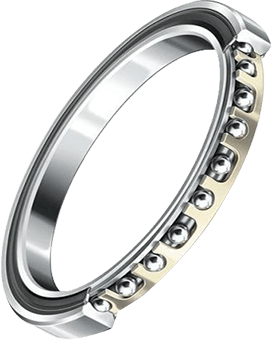
Industrial robot bearings Replacement standard. A combination of the following factors should be considered:
Wear clearance: Measure the radial clearance of the bearing using a dial gauge and replace it when it exceeds 1.5 times the initial clearance. Precision robot spherical bearings usually require clearance control of 5-15μm, beyond which the positioning accuracy will be directly affected.
Surface state:Endoscopic inspection or disassembly measurement shows that the scratch depth is >0.01mm, the pitting area is >1mm², or there is peeling. Cross roller bearings for harmonic reducers are particularly sensitive to surface state, and even slight damage can cause a significant increase in vibration.。
Operational accuracy: The decrease in the rotation accuracy of the robot spherical bearing is directly manifested in the increase of the repeated positioning error. When the error exceeds 50% of the allowable value and cannot be corrected by calibration, bearing replacement should be considered.
Lubricating properties:The performance maintenance time of grease after replenishment is significantly shortened (e.g. less than 1/3 of the original period), or the base oil precipitates quickly (precipitation amount > 5% in 24 hours), indicating that the bearing or lubricant can no longer meet the requirements。
Table: Identification and treatment measures of lubrication status of high-speed miniature ball bearings for industrial robots
| Monitoring indicators | Normal range | Pay attention to thresholds | Vigilance thresholds | Replacement standard | Measures |
|---|---|---|---|---|---|
| Vibration velocity | <2.0mm/s | 2.0-3.5mm/s | 3.5-4.5mm/s | >4.5mm/s | Check lubrication and shorten cycles |
| temperature | ΔT<30℃ | ΔT30-40°C | ΔT40-50°C | ΔT>50℃ | Check the amount of filling, change the fat |
| noise | <70dB | 70-75dB | 75-80dB | >80dB | Check for wear and tear and prepare for replacement |
| Clearance | <Initial 1.2 times | 1.2-1.5 times | 1.5-2.0 times | >2.0Times | Replace the bearing immediately |
| Positioning error | <Nominal value | 1-1.3 times nominal | 1.3-1.5 times nominal | >1.5Times nominal | Calibrate or replace bearings |
advanced Predictive maintenance technology It is being applied in the field of industrial robots. IoT-based smart bearings are equipped with temperature and vibration sensors that transmit data in real time to a cloud-based analytics platform. Machine learning algorithms are trained on historical data to predict lubrication failures 200-500 operating hours in advance, with an accuracy rate of more than 85%. Some high-end lubrication systems even have closed-loop control, automatically adjusting the amount and cycle time based on real-time monitoring data. Despite the high initial investment, the payback period for such systems on critical production lines is typically less than 18 months.
Bearings Replace work There is also a need for standardized operations. Preparation includes obtaining the correct spare parts (note the difference in bearing suffix codes), preparing special tools (hydraulic nuts, induction heaters, etc.), and a clean working environment. Key steps include: accurate recording of the mounting position and orientation of the original bearing; Use suitable disassembly tools to avoid journal damage; Measure the relevant fit dimensions to ensure that the new bearings are matched; Control the installation temperature (heating does not exceed 120°C) and press-fitting force (not more than 50% of the rated static load of the bearing); Strictly follow the manufacturer's specified preload and clearance adjustment methods. After replacement, the running monitoring should be carried out for at least 48 hours, and the temperature and vibration should be checked every 8 hours at the initial stage to confirm that the operation status is stable.
Lubrication management informatization It is an important way to improve maintenance efficiency. A modern computerized maintenance management system (CMMS) tracks the lubrication history, monitoring data, and maintenance schedules of each bearing, enabling the transition from empirical to data-driven decision-making. System functions should include: automatic generation of lubrication roadmaps and work instructions, barcode/RFID identification of lubrication points, mobile terminal data collection, and analysis report generation. Such systems can reduce human error by more than 30% while improving the standardization and traceability of maintenance work.
Bearing lubrication management for industrial robots has evolved from simple periodic maintenance to a comprehensive discipline that integrates materials science, sensing technology, and data analysis. With the advancement of Industry 4.0 and the diversification of robot application scenarios, lubrication technology is facing new ones Challenges and opportunities。 This section will discuss advanced strategies for lubrication maintenance, introduce cutting-edge technology developments in the industry, and provide lubrication solutions for special applications to help you build a future-proof robotic bearing maintenance system.
Lubricant technology Recent advancements are redefining maintenance cycles. While traditional greases typically last less than 4,000 hours at high speeds and temperatures, the new fully synthetic grease extends its service life to 10,000-15,000 hours through base oil refining and additive optimization. Breakthrough products such as polyetherketone (PIKE) thickener greases maintain a stable structure at temperatures up to 200°C, extending lubrication intervals by a factor of 3-5. Advances have also been made in solid lubrication technology, with graphene-reinforced greases with a coefficient of friction as low as 0.05, making them particularly suitable for extreme environments such as high vacuum or strong radiation. Of interest is the rise of "smart lubricants", which contain temperature- or pressure-sensitive microcapsules that automatically release active substances when friction increases, enabling adaptive lubrication.
Sealing technology The innovation also improves lubrication. While traditional contact seals generate too much heat at high speeds, non-contact labyrinth seals struggle to block micron-sized particles. The latest developments Magnetic fluid seals.Creates a liquid barrier between stationary and rotating parts for zero leakage and virtually wear-free operation. Test data shows that robot spherical bearings with this seal can hold grease up to 50% longer and contaminants less by 90%. On the other hand, there is the self-healing sealing material, which automatically migrates to the damage and "self-healing" when a small leak is detected, greatly reducing the risk of lubricant contamination.
From the perspective of maintenance methods,Automatic lubrication system It is becoming more and more popular in high-end robot applications. These systems regularly replenish the bearing chamber with fresh grease via a dosing distributor while draining some of the old grease to keep the lubricant in good condition at all times. Compared to manual lubrication, automatic systems reduce lubrication-related failures by up to 70% while reducing lubricant consumption by 30%-40%. The more advanced closed-loop control system integrates an in-line viscometer and particle counter to monitor the lubricant status in real time and accurately replenish it according to actual needs, achieving the ideal state of "never replace, just replenish". Although the initial investment is higher, these systems usually pay for themselves within 12-18 months on a 24/7 continuous production line.
Condition monitoring technology Advances in predictive maintenance have made predictive maintenance more precise. The multi-parameter sensing node can measure vibration, temperature, humidity and lubricant dielectric constant at the same time, extract feature values through edge computing, and then transmit them to the cloud platform for analysis through 5G. The bearing remaining life prediction algorithm developed by NASA in the United States, combined with physical models and machine learning, has a prediction accuracy of ±5%. Some manufacturers of industrial robots have begun to embed miniature sensors in their original bearings to monitor lubrication film thickness and metal wear particles in real time, and this data is directly integrated with the robot's control system to automatically adjust operating parameters or trigger maintenance work orders before lubrication fails.
Special application environments Targeted lubrication solutions are needed. In the food and pharmaceutical industry, NSF H1 certified lubricants are essential, and the latest trend is to use synthetic ester-based oil-free greases to completely eliminate the risk of contamination. Cleanroom robots tend to use low-volatile silicone-based or perfluoropolyether (PFPE) lubricants, the outgassing of which can be controlled at <0.1%. In extreme temperature environments such as foundries, ceramic bearings combined with graphite lubrication are an emerging option that can withstand high temperatures above 800°C. For robots used in deep-sea or polar regions, biodegradable lubricants not only meet environmental protection requirements, but their low-temperature performance is also better than traditional products。
Maintenance strategy optimization Need to scale from a single piece of equipment to an entire production line. By analyzing lubrication data and fault logs from multiple robot bearings, it is possible to identify common problems (e.g., overload at one station) or system defects (e.g., uneven distribution of centralized lubrication systems). The Statistical Process Control (SPC) method helps to distinguish between random fluctuations and true anomalies, avoiding excessive maintenance. Applying this method to an automotive welding line reduced lubrication-related downtime by 45% and increased the average bearing life by 60%. Another effective strategy is Reliability-Based Maintenance (RBM), which focuses limited maintenance resources on the weak areas where it is most likely to cause significant losses by conducting a Failure Mode and Effects Analysis (FMEA) on critical bearings.
industry Future Trends Including nano lubrication technology, digital twin and green lubrication. Additives such as graphene and molybdenum disulfide nanotubes show amazing lubricating properties and achieve near-zero wear in the laboratory. Digital twin technology supports maintenance decisions by virtually replicating the physical bearing to simulate the effects of different lubrication strategies. Stricter environmental regulations are driving the development of bio-based lubricants, and some new products based on vegetable oils are approaching synthetic oil levels. With the rise of emerging applications such as humanoid robots, new challenges are posed for miniature ultra-precision bearing lubrication, which may lead to more breakthrough solutions.
Implementing a successful lubrication maintenance program requires:Organizational safeguards and Personnel training。 It is recommended to set up a special lubrication engineer position to be responsible for lubricant selection, cycle formulation and technical research. Operator training should cover three dimensions: basic knowledge (e.g., lubrication principles), skills (e.g., grease gun use), and safety (e.g., chemical handling). Certification programs such as the International Society of Mechanical Lubrication (ICML) MLT and MLA certifications enhance the professionalism of the team. Systematically trained maintenance teams have been shown to reduce lubrication-related decision-making errors by up to 65% and increase overall equipment effectiveness (OEE) by 5-15 percentage points.
Finally, it is worth emphasizing that lubrication is maintained Continuous improvement A knowledge management system needs to be established. Record the details of each lubrication activity (including lubricant batch, operator, environmental conditions, etc.) and subsequent performance changes for a traceable data chain. Lubrication analysis meetings are held regularly (e.g., quarterly) to evaluate maintenance effectiveness and adjust strategies. Maintain technical communication with lubricant suppliers, bearing manufacturers and robot OEMs to get the latest solutions in a timely manner. This systematic, knowledge-driven approach transforms lubrication from a cost center to a value-creating activity, giving businesses a substantial competitive advantage.

Vincent Liang

+86 137 5749 2228

liangzexi@cxbearings.cn

No.195, Dongshaobei Road, Jiangbei District, Ningbo City, Zhejiang Province, China


Copyright © Zhejiang Dacheng Precision Machinery Co., Ltd. All Rights Reserved.

