 DACHENG PRECISION MACHINERY

High-accuracy OEM equipment—such as CNC machining centers, semiconductor tools, medical devices, and precision automation systems—depends heavily on bearing performance. As tolerances tighten and operating conditions become more demanding, standard bearing solutions often fail to meet requirements for dimensional stability, corrosion resistance, and repeatable accuracy. This has driven steady demand for 440C precision grade stainless steel bearings, particularly in markets where reliability, cleanliness, and long service life directly affect total cost of ownership.
In Europe and North America, OEMs increasingly specify stainless steel bearings not only for corrosion resistance but also for predictable performance under variable temperature, speed, and load conditions. Among stainless steels, 440C has become a reference material for high-precision applications where both hardness and wear resistance are critical.
440C is a high-carbon martensitic stainless steel containing approximately 16–18% chromium. Unlike austenitic grades such as 304 or 316, 440C can be through-hardened by heat treatment, enabling bearing rings and rolling elements to achieve hardness levels comparable to bearing steels while retaining stainless properties.
When manufactured to precision grade standards, these bearings exhibit tightly controlled radial runout, raceway geometry, and surface finish. This combination supports consistent rotational accuracy and low vibration—key requirements for high accuracy OEM equipment.
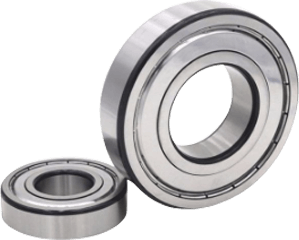
A typical 440C precision bearing consists of inner and outer rings, balls, and a cage, all produced under strict dimensional control. Rings and balls are usually made from vacuum-melted or ESR-refined 440C to ensure material cleanliness and uniform microstructure.
Key manufacturing steps include:
Precision forging or machining of rings to near-net shape
Controlled heat treatment to achieve target hardness while minimizing distortion
Precision grinding and superfinishing of raceways to achieve low surface roughness
Selective assembly based on measured dimensions to maintain tight internal clearance
The result is a bearing capable of supporting high rotational accuracy over long operating cycles, even in moderately corrosive or cleanroom environments.
Several variables directly influence the performance of 440C precision bearings:
Material purity – Non-metallic inclusions can initiate fatigue failure under cyclic loads.
Heat treatment consistency – Variations in hardness or retained austenite affect wear resistance and dimensional stability.
Geometric accuracy – Raceway roundness and ball sphericity determine vibration levels and positioning accuracy.
Lubrication compatibility – Many OEM applications require low-outgassing or food-grade lubricants, which must match surface finish and operating speed.
OEM engineers typically evaluate these factors during qualification, rather than relying solely on catalog specifications.
Choosing the right supplier is critical for OEM programs that rely on stable long-term performance. Beyond ISO certification, experienced buyers assess:
Traceability of raw materials and heat treatment batches
In-house inspection capability for runout, noise, and surface finish
Process consistency across production lots
Engineering support for application-specific requirements
Suppliers with a proven track record in Precision Bearings manufacturing are better positioned to support customization, validation testing, and lifecycle management.
Despite their advantages, 440C precision bearings are sometimes misapplied. A common issue is assuming all stainless bearings offer the same corrosion resistance; in highly aggressive chemical environments, 440C may underperform compared to 316-based solutions. Another challenge is balancing hardness and corrosion resistance—improper heat treatment can compromise one or the other.
OEMs also face lead-time variability when sourcing high-precision components, particularly for small batches or non-standard configurations.
440C precision grade bearings are widely used in:
High-speed spindles for machining and inspection equipment
Servo motors and feedback systems requiring low runout
Medical imaging and diagnostic devices where cleanliness matters
Semiconductor handling and metrology tools
In these applications, Precision Grade Stainless Steel Bearings help maintain system accuracy over extended service intervals, reducing recalibration and downtime.
The market is moving toward tighter tolerances, cleaner manufacturing processes, and increased demand for application-specific validation data. Hybrid designs combining 440C rings with ceramic balls are gaining traction where higher speeds or reduced lubrication are required. At the same time, digital quality records and predictive maintenance data are becoming part of OEM sourcing requirements.
As automation and precision manufacturing continue to expand, Stainless Steel Bearings made from 440C will remain a key solution where accuracy, durability, and moderate corrosion resistance must coexist.
Is 440C suitable for cleanroom applications?
Yes, when properly finished and lubricated, it is commonly used in clean manufacturing environments.
How does 440C compare to chrome steel?
440C offers better corrosion resistance, while chrome steel may provide higher fatigue life in dry, non-corrosive conditions.
Can these bearings be customized for OEM projects?
Many manufacturers offer clearance control, sealing options, and lubrication tailored to specific equipment needs.

Vincent Liang

+86 137 5749 2228

liangzexi@cxbearings.cn

No.195, Dongshaobei Road, Jiangbei District, Ningbo City, Zhejiang Province, China


Copyright © Zhejiang Dacheng Precision Machinery Co., Ltd. All Rights Reserved.

